
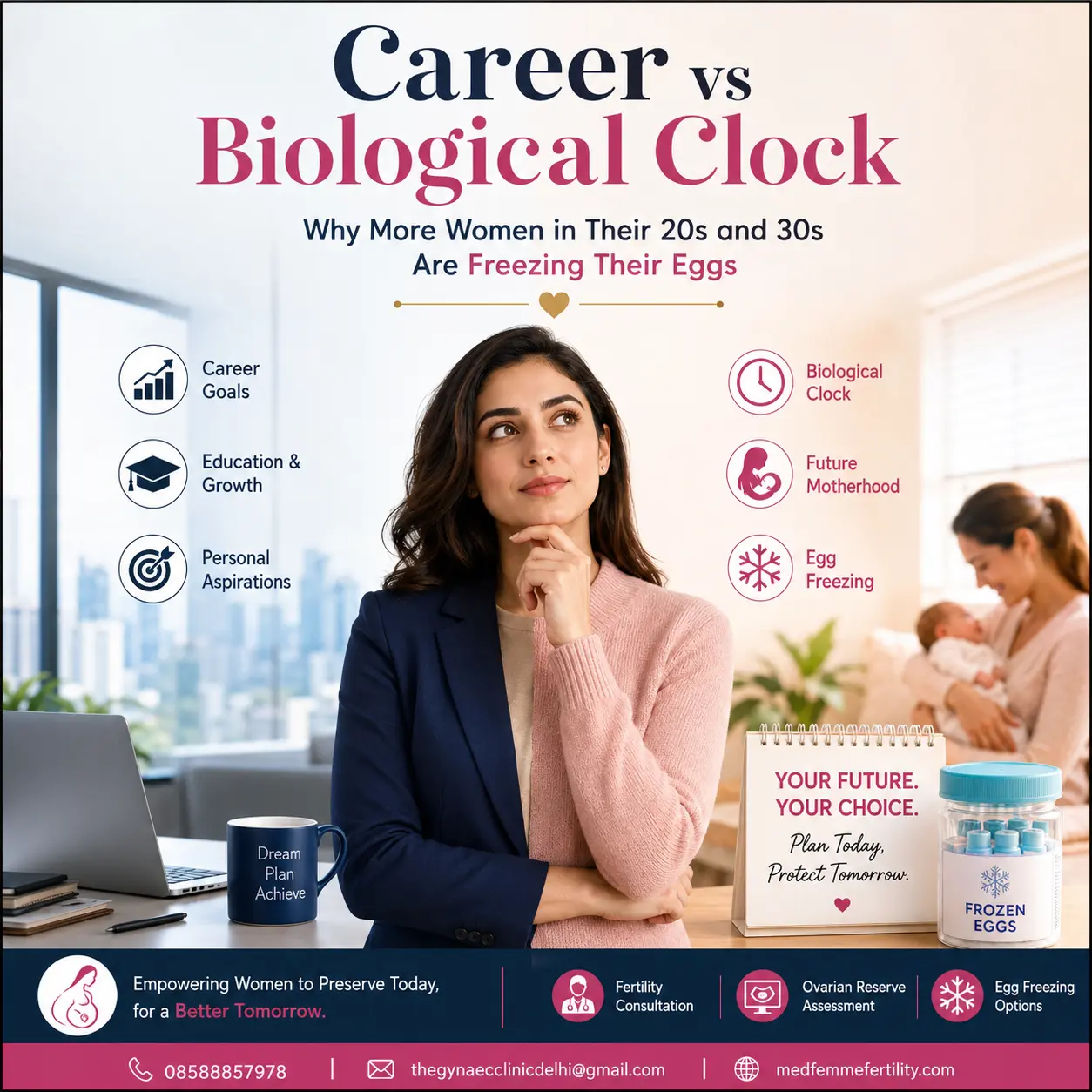
“Should I focus on my career now and think about having children later?”
This is one of the most common questions fertility specialists hear from women in their late 20s and early 30s.
Modern women are breaking barriers in education, entrepreneurship, leadership, and global careers. At the same time, many are delaying marriage or motherhood until they feel emotionally, professionally, or financially ready.
However, while careers can wait, the biological clock doesn’t pause.
The good news? Thanks to advances in fertility medicine, women no longer have to choose between career ambitions and future motherhood. Egg freezing has emerged as a powerful fertility preservation option, giving women more control over their reproductive future.
If you’re wondering whether Career vs Biological Clock is a choice you have to make, this guide explains everything you need to know.
What Does “Career vs Biological Clock” Really Mean?
The phrase Career vs Biological Clock reflects the challenge many women face today—balancing personal ambitions with the natural decline in fertility.
Unlike men, women are born with a fixed number of eggs. Every month, the quantity and quality of these eggs gradually decrease. This process accelerates after the age of 35, making conception more difficult.
This doesn’t mean every woman will struggle to conceive after 35. But statistically, fertility declines because:
- The number of healthy eggs reduces.
- Egg quality decreases over time.
- The chances of miscarriage increase.
- Chromosomal abnormalities become more common.
Understanding this biological reality empowers women to make informed decisions rather than rushed ones.
Why Are More Women Choosing Egg Freezing?
A decade ago, egg freezing was primarily recommended for women undergoing cancer treatment. Today, it has become a proactive fertility planning tool for healthy women.
Here are the most common reasons:
1. Career Growth Without Fertility Pressure
Building a successful career often requires years of dedication, advanced education, travel, and professional growth.
Many women prefer to establish themselves before starting a family. Egg freezing allows them to preserve younger, healthier eggs while continuing to pursue their goals.
2. Waiting for the Right Partner
Many women know they want children—but they don’t want to compromise on finding the right life partner.
Instead of feeling pressured by age, egg freezing offers valuable reproductive flexibility.
3. Financial Stability
Raising a child requires emotional and financial readiness.
Many couples prefer to achieve financial security before expanding their family.
4. Medical Conditions Affecting Fertility
Doctors may recommend fertility preservation for women diagnosed with:
- Endometriosis
- Ovarian cysts
- Autoimmune disorders
- Certain genetic conditions
Women undergoing chemotherapy or radiation therapy are also encouraged to consider egg freezing before treatment.
What Is Egg Freezing?
Egg freezing, medically known as oocyte cryopreservation, is a fertility preservation technique where mature eggs are collected, frozen using advanced vitrification technology, and stored for future use.
When you’re ready for pregnancy:
- The eggs are thawed.
- Fertilized using IVF or ICSI.
- The resulting embryo is transferred into the uterus.
Modern vitrification techniques have significantly improved egg survival rates, making egg freezing a reliable fertility preservation option.
When Is the Best Time to Freeze Your Eggs?
One of the biggest myths surrounding Career vs Biological Clock is that women should wait until fertility becomes a concern.
In reality, younger eggs have better quality.
Fertility specialists generally recommend:
| Age | Recommendation |
| Under 30 | Usually not necessary unless medically advised |
| 30–34 | Ideal age for elective egg freezing |
| 35–37 | Still beneficial but more eggs may be required |
| 38–40 | Possible, though success rates gradually decline |
| Above 40 | Individual fertility assessment is essential |
The younger the eggs at the time of freezing, the higher the likelihood of future pregnancy success.
How Does the Egg Freezing Process Work?
The entire process typically takes about 2 to 3 weeks.
Step 1: Fertility Assessment
Your fertility specialist evaluates:
- AMH (Anti-Müllerian Hormone)
- Antral Follicle Count (AFC)
- Hormone profile
- Pelvic ultrasound
These tests help determine ovarian reserve and personalize treatment.
Step 2: Ovarian Stimulation
Hormonal injections stimulate multiple eggs to mature simultaneously.
Regular ultrasound scans monitor follicle growth.
Step 3: Egg Retrieval
A short, minimally invasive procedure performed under light anesthesia retrieves mature eggs from the ovaries.
Most women return home the same day.
Step 4: Vitrification
Healthy mature eggs are rapidly frozen using vitrification, preventing ice crystal formation and preserving egg quality for future use.
Does Egg Freezing Guarantee Pregnancy?
No—and it’s important to understand this.
Egg freezing is not an insurance policy, but it is one of the most effective fertility preservation options available today.
Success depends on factors such as:
- Age at egg freezing
- Number of eggs frozen
- Egg quality
- Overall reproductive health
- Sperm quality during IVF
Freezing eggs at a younger age generally offers better chances of achieving pregnancy later.
Is Egg Freezing Right for You?
You may benefit from consulting a fertility specialist if you:
✔ Are between 28 and 35 years old
✔ Want to delay pregnancy for career or personal reasons
✔ Haven’t found the right partner
✔ Have a family history of early menopause
✔ Have endometriosis or ovarian conditions
✔ Need medical treatment that may affect fertility
A fertility consultation doesn’t mean you must freeze your eggs—it simply helps you understand your reproductive timeline.
Career vs Biological Clock: It’s About Choice, Not Sacrifice
The conversation around Career vs Biological Clock is evolving.
Today’s women shouldn’t feel forced to choose between professional success and motherhood. Fertility preservation allows women to plan pregnancy on their own timeline while acknowledging the realities of reproductive biology.
Egg freezing isn’t about delaying motherhood forever—it’s about creating more options for the future.
Knowledge, planning, and timely fertility assessment can help you make decisions with confidence instead of uncertainty.
Frequently Asked Questions (FAQs)
At what age should I consider egg freezing?
Most fertility experts recommend considering egg freezing between 30 and 35 years, when egg quality is generally at its best.
How long can frozen eggs be stored?
Frozen eggs can remain safely preserved for many years without losing quality when stored under proper laboratory conditions.
Is egg freezing painful?
Most women experience mild bloating during ovarian stimulation. Egg retrieval is performed under anesthesia, making the procedure comfortable.
Can I still conceive naturally after freezing my eggs?
Yes. Egg freezing does not affect your ability to become pregnant naturally in the future.
Is egg freezing only for career-focused women?
No. Women choose egg freezing for many reasons, including medical conditions, delayed marriage, personal goals, or fertility preservation before cancer treatment.
Final Thoughts
The discussion around Career vs Biological Clock is no longer about choosing one dream over another. It’s about empowering women with information, advanced reproductive technology, and the freedom to make decisions that align with their lives.
If you’re in your late 20s or 30s and wondering how age may impact your fertility, a fertility assessment today can provide valuable insights. At Medfemme Women’s Clinic, Hauz Khas, South Delhi, Dr. Tejashri Shrotri offers personalized fertility counselling, ovarian reserve testing, and egg freezing guidance to help women preserve their reproductive choices with confidence.
Your career has a timeline. Your fertility does too. Understanding both can help you plan the future you truly want.
