
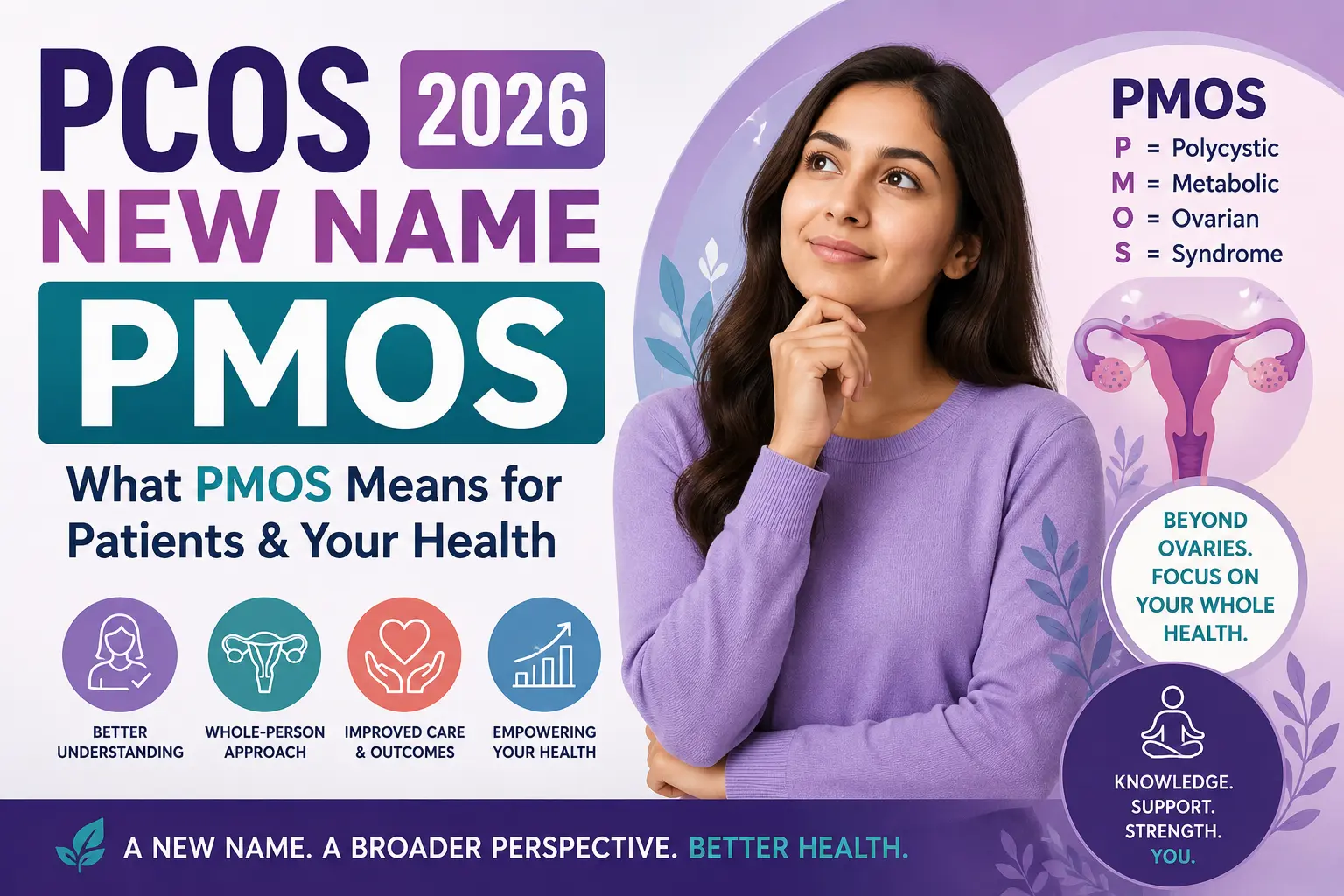
If you have been living with polycystic ovary syndrome — or suspect you might — you have probably already heard the news that has been making waves in the world of women’s health. On May 12, 2026, after more than a decade of global research, patient advocacy, and scientific collaboration, PCOS officially got a new name. It is now called PMOS — Polyendocrine Metabolic Ovarian Syndrome.
For millions of women who have spent years navigating confusing symptoms, delayed diagnoses, and fragmented care, this is more than a terminology update. This is a long-overdue recognition that PCOS is not just an ovary problem. It is a whole-body condition — one that affects hormones, metabolism, mental health, skin, and cardiovascular health all at once.
So what does the pcos new name actually mean for you as a patient? Does your diagnosis change? Does your treatment plan change? And why did it take this long? In this article, your trusted PCOS treatment doctor breaks it all down — clearly, compassionately, and without the medical jargon.
What Is the PCOS New Name — And Why Was It Changed?
The pcos new name is Polyendocrine Metabolic Ovarian Syndrome, abbreviated as PMOS. The change was officially published in The Lancet on May 12, 2026, and presented at the European Congress of Endocrinology in Prague. It was endorsed by over 56 leading academic, clinical, and patient organisations worldwide — including the Endocrine Society, the American Society for Reproductive Medicine (ASRM), and dozens of patient-led advocacy groups.
The decision did not happen overnight. It was the result of the most extensive disease-renaming process in medical history — spanning 11 years, involving 22,000 patients, doctors, researchers, and charities across six continents.
The key problem with the old name? “Polycystic Ovary Syndrome” implied that the condition was primarily about ovarian cysts. But research has shown for years that:
- There is no increase in actual pathological ovarian cysts associated with the condition.
- The condition is driven by complex hormonal and metabolic dysfunction — not by cysts.
- Many women with PCOS do not have visible cysts at all.
- The old name contributed to missed diagnoses, stigma, and a narrow focus on fertility — while ignoring the metabolic, cardiovascular, and mental health dimensions.
In fact, the World Health Organization estimates that 70% of people with this condition remain undiagnosed. A misleading name has been one of the contributing factors.
What Does PMOS Stand For — And What Does It Mean?
Breaking down the pcos new name 2026 — PMOS — tells you exactly what the condition actually is:
| P — Poly | Multiple — acknowledging the many systems involved |
| E — Endocrine | Hormonal — reflecting the role of insulin, androgens, LH, and other hormones |
| M — Metabolic | Metabolism-related — including insulin resistance, weight, blood sugar, and cardiovascular risk |
| O — Ovarian | Ovarian — still acknowledging the reproductive impact, including irregular periods and fertility challenges |
| S — Syndrome | A collection of related symptoms — not a single disease with one cause |
Simply put: the new name tells the truth about what this condition really is.
Does Your Diagnosis or Treatment Change?
This is the question most patients are asking — and the answer is reassuring. Your diagnosis does not change. PCOS and PMOS describe the exact same condition. A prior PCOS diagnosis carries forward as PMOS with no clinical differences. You do not need a new test, a new referral, or a new medical file.
Both names will appear in medical records, prescriptions, and patient materials during a planned three-year transition period. So do not be confused if your reports still say PCOS — it simply means the transition is still underway.
What may begin to change — for the better — is:
- How doctors across specialties approach the condition (endocrinology, cardiology, dermatology, mental health — not just gynaecology)
- How research funding is prioritised and allocated
- How the condition is classified in international disease systems
- How medical education trains future doctors to diagnose and treat it
- How patients themselves understand and advocate for their health
Why the PCOS New Name 2026 Matters More Than You Think
For many women, hearing about the pcos new name 2026 has been an emotional moment — and that response is completely valid. This renaming is a form of validation. It says: we hear you. The weight gain, the fatigue, the mood swings, the acne, the irregular cycles, the anxiety — none of that was “just hormones.” It is a complex, multisystem condition that deserved to be taken seriously.
The Stigma Problem
The old name carried enormous stigma. Many women were told their symptoms were “just weight-related” or dismissed when they did not present with visible cysts. The PMOS renaming helps dismantle this stigma by shifting the clinical focus from appearance to biology — from ovaries to the entire endocrine and metabolic system.
The Underdiagnosis Problem
The WHO estimates that 70% of women with this condition are undiagnosed. One major reason: the name “polycystic ovary syndrome” led patients and sometimes even clinicians to look for cysts — and when cysts were absent, the diagnosis was missed. With PMOS, the focus moves to the hormonal and metabolic markers that are far more consistent and clinically meaningful.
The Research Problem
When a condition is named after a feature it does not always have, research funding and clinical guidelines tend to follow that narrow framing. The renaming to PMOS opens the door for research into metabolic subtypes, neuroendocrine drivers, cardiovascular risk, and personalised treatment approaches — research that was previously underfunded or fragmented.
Symptoms That Now Make More Sense Under PMOS
One of the most powerful outcomes of the pcos new name is that patients can now understand their symptoms through a wider, more accurate lens. PMOS recognises that this condition can affect your body in all of the following ways:
- Hormonal symptoms: Irregular or absent periods, high androgen levels, excess facial/body hair (hirsutism), acne, scalp hair thinning
- Metabolic symptoms: Insulin resistance, weight gain especially around the abdomen, difficulty losing weight, high blood sugar, elevated cholesterol
- Reproductive symptoms: Difficulty conceiving, anovulation, irregular ovulation, increased risk of gestational diabetes
- Cardiovascular symptoms: High blood pressure, elevated cardiovascular risk, dyslipidaemia
- Dermatological symptoms: Acne, oily skin, darkening of skin in folds (acanthosis nigricans)
- Psychological symptoms: Anxiety, depression, low self-esteem, mood disturbances
Under PMOS, every single one of these symptom clusters is acknowledged — not just the reproductive ones.
What Should You Do Now? Talk to a PCOS Treatment Doctor
Whether you were diagnosed years ago or are only now beginning to connect the dots on your symptoms, this is the right time to seek proper care from a pcos treatment doctor who understands the full picture of PMOS.
A specialist-led PMOS evaluation typically includes:
- Hormonal blood panel (LH, FSH, testosterone, insulin, thyroid)
- Metabolic screening (fasting glucose, HbA1c, lipid profile, blood pressure)
- Ultrasound assessment of ovarian morphology
- Psychological health evaluation
- Personalised treatment planning based on your specific hormonal and metabolic profile
Treatment approaches may include lifestyle modifications, hormonal therapy, insulin-sensitising medications like Metformin, fertility support if needed, and mental health counselling. No single approach works for everyone — and the PMOS framework now makes it easier to create truly personalised treatment plans.
A Patient’s Perspective: What the Name Change Really Feels Like
“I was told for years that I just needed to lose weight. My periods were irregular, I was exhausted all the time, my skin was terrible — and no one connected the dots. When I was finally diagnosed with PCOS, I was relieved but also confused. I didn’t have cysts. The name never made sense to me. When I heard it was being renamed PMOS, I actually cried. It felt like the medical world was finally admitting that this condition is real, it is complex, and it affects your whole life — not just your ability to have children.”
— A patient living with PMOS, sharing her experience
Conclusion: The PCOS New Name Is a Step Toward Better Care
The pcos new name — PMOS, or Polyendocrine Metabolic Ovarian Syndrome — is more than a rebrand. It is a scientific correction backed by 11 years of global research and over 22,000 voices. It is a shift in how medicine sees this condition: not as a niche gynaecological problem, but as a complex, whole-body syndrome that deserves comprehensive, multidisciplinary care.
For patients, the pcos new name 2026 is a source of validation. For doctors, it is a call to look beyond the ovaries. For researchers, it is an invitation to explore the full metabolic and hormonal complexity of a condition that affects 1 in 8 women worldwide.
If you have been diagnosed with PCOS — now PMOS — or suspect you may have it, this is the right moment to connect with a dedicated pcos treatment doctor who will treat your whole health, not just your ovaries.
Ready to Get the Right Care for PMOS?
You deserve more than a diagnosis. You deserve a comprehensive, personalised treatment plan from specialists who understand the full picture of PMOS — hormonal, metabolic, reproductive, and emotional.
- Book a Consultation — Speak with our experienced PCOS/PMOS specialists.
- Call Us Today — Get your questions answered by our care team.
- Schedule Your Appointment — We will run a complete PMOS evaluation tailored to you.
- WhatsApp Us — Chat with our team for quick queries and appointment bookings.
Do not wait for your symptoms to get worse. Early diagnosis and personalised care lead to better long-term outcomes. Your health journey begins with one conversation.
Frequently Asked Questions (FAQs)
What is the PCOS new name in 2026?
The pcos new name 2026 is Polyendocrine Metabolic Ovarian Syndrome, abbreviated as PMOS. The change was officially announced on May 12, 2026, following a 11-year global consensus process led by Monash University researchers and endorsed by over 56 patient and medical organisations, including the Endocrine Society and ASRM. The name was published in The Lancet.
Does the PCOS name change affect my diagnosis?
No. Your diagnosis remains exactly the same. PCOS and PMOS describe the identical condition. A prior PCOS diagnosis carries forward as PMOS with no clinical difference. You will not need any new tests or referrals. Both names will appear in medical documents during the planned three-year transition period.
Why was PCOS renamed to PMOS?
PCOS was renamed because the original term was scientifically inaccurate and misleading. It implied pathological ovarian cysts, which are not a defining feature of the condition. The new name — PMOS — more accurately reflects the hormonal (polyendocrine) and metabolic nature of the syndrome. This is expected to reduce stigma, improve diagnosis rates, and encourage broader treatment approaches.
Will my PCOS treatment change after the renaming?
Current diagnostic criteria and treatment protocols remain unchanged by the renaming. However, the new PMOS framing is expected to gradually shift clinical practice toward more holistic, multidisciplinary care — addressing not just fertility, but also metabolic, cardiovascular, dermatological, and psychological health. Future research may also refine personalised treatment subtypes under the PMOS framework.
What does PMOS stand for?
PMOS stands for Polyendocrine Metabolic Ovarian Syndrome. Each word matters: Poly (multiple systems involved), Endocrine (hormonal complexity — including insulin, androgens, and other hormones), Metabolic (recognising the metabolic and cardiovascular impact), Ovarian (acknowledging the reproductive and ovarian involvement), and Syndrome (a cluster of related symptoms).
Can I still see a PCOS treatment doctor after the name change?
Absolutely. Specialists who have been treating PCOS are now treating PMOS — it is the same expertise, same condition, and same clinical approach. If anything, the PMOS framework allows your doctor to address the full spectrum of your health, beyond just reproductive issues. Ask about a comprehensive PMOS evaluation during your next appointment.
How long will the transition from PCOS to PMOS take?
A three-year transition roadmap has been planned by the global coalition that announced the change. During this period, both PCOS and PMOS will appear interchangeably in medical records, research publications, clinical guidelines, and patient materials across 195 countries. Gradual adoption is expected across all healthcare settings globally.
